
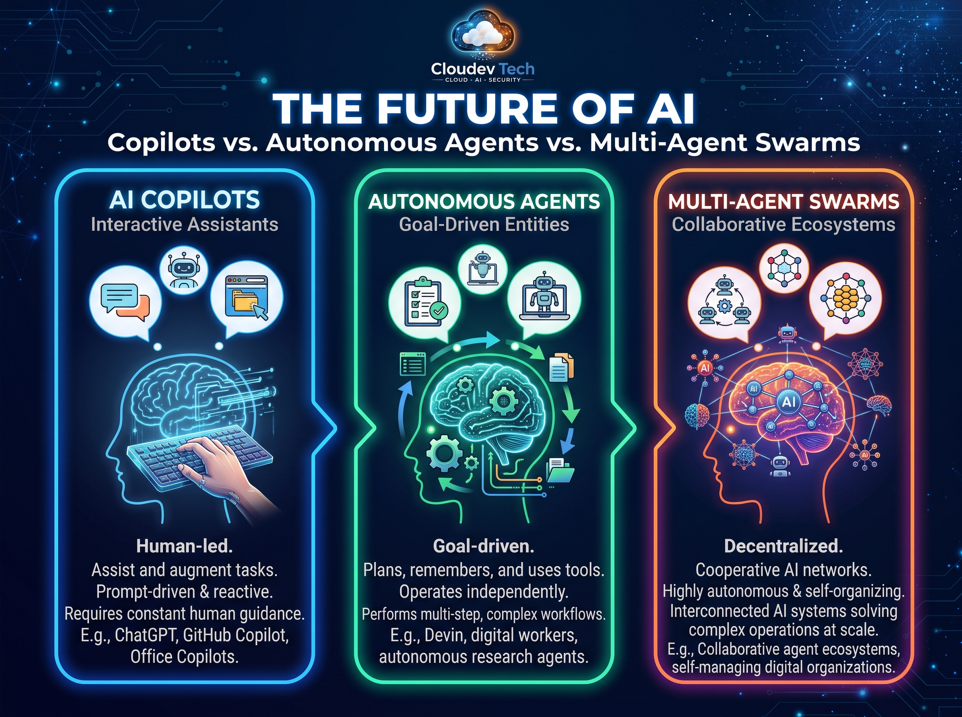
Many teams roll out an AI assistant and then realize the real question isn’t which model to use, but how much autonomy to grant. Autonomous agents, copilots, and multi-agent swarms are not just branding labels. Each one changes your identity model, blast radius, and operating cost, so the choice deserves an architectural decision, not a product demo.
In This Article
AI Copilots: Human-Led and Prompt-Driven
Unlike autonomous agents, copilots such as GitHub Copilot and Microsoft 365 Copilot assist a person who stays in the loop. Every action starts with a human prompt, which keeps risk comparatively low and accountability clear. The control that matters most is data access. A copilot can only summarize or draft from what the signed-in user can already reach, so oversharing in SharePoint, Teams, and mailboxes becomes the real exposure.
Before a wide rollout, review permissions with least-privilege in mind, apply sensitivity labels, and use Microsoft Purview to protect and monitor sensitive content. Copilots are also reactive, which is where autonomous agents take over. They rarely run without a person watching, so they are a poor fit for work that must happen on a schedule or across many systems.
Autonomous Agents: Goal-Driven Workflows
An autonomous agent receives a goal, plans the steps, remembers context, and calls tools to finish multi-step work. That power is exactly why identity design comes first. Give each agent its own workload identity in Microsoft Entra ID instead of a shared service account, and scope its permissions to the specific tools it needs.
Expose tools through narrow, typed interfaces, for example, MCP servers that your security team can approve, published behind an API gateway with OAuth 2.0 and rate limits. Start with read-only tools, add write actions one at a time, and require human approval for anything that changes state or moves money. Log every tool call so a reviewer can reconstruct what the agent did and why. Platforms such as Microsoft AI Foundry and Azure OpenAI provide the model layer, but the guardrails around tools and identity are what your security team will actually assess.
Multi-Agent Swarms: Coordination at Scale
Swarms split a large problem across specialized autonomous agents that cooperate, for example, one that retrieves data, one that analyzes it, and one that drafts or executes a change. This can handle operations that no single agent manages well, but the failure modes multiply. Agents can loop, amplify each other’s errors, or take actions nobody explicitly approved.
Treat coordination as an engineering problem. Define a single orchestrator with clear authority, set budgets for tokens and tool calls, and add timeouts so one runaway loop cannot become an outage. Keep an audit trail that ties every agent action back to a named human owner. Network controls matter too: restrict which systems each agent can reach, and run the workloads on Kubernetes with network policies, managed secrets, and infrastructure defined in Terraform so every environment is reproducible and reviewable.
How to Choose the Right Model
Start with a copilot where a person reviews every output. Move to agents for repeatable workflows that have clear success criteria and a measurable definition of done. Adopt swarms only when a single autonomous agent cannot meet the need, and only after identity, logging, and cost controls are proven at the agent level.
Common mistakes include granting autonomous agents broad shared credentials, skipping approval steps for write actions, and measuring success by demo quality instead of by audit and incident data. Pair every deployment with monitoring in Microsoft Sentinel and Defender for Cloud, and align controls with frameworks such as NIST CSF or SOC 2 where they apply. These practices support compliance efforts, but no single control guarantees compliance or removes all risk.
Planning your AI roadmap and unsure where copilots end and agents begin? Book a consultation with CloudevTech and we will help you design governed, secure AI infrastructure.
#AgenticAI #AIAgents #MCP #CloudSecurity #CloudevTech